

How to Con an AI

AIs can perform well at all kinds of tasks, such as interpreting images or text. For example, these days deep neural networks (DNNs) get over 90% accuracy on the IMAGENET benchmark database, which requires recognition of over 20,000 types of objects in over 14 million images.

Even though today’s deep neural networks have roots in early attempts to mathematically model the human brain and nervous system, the ‘knowledge’ possessed by DNNs takes a form quite different from a human’s.

Just as a picture of a school bus is only a bunch of numbers to an AI (red, green and blue brightness levels for each pixel), an AI’s ‘knowledge’ is also only a bunch of numbers – its mathematical parameters.

Each parameter is like a calibration value, and large DNNs have billions of them. Through an exhaustive training process, millions or billions of examples are presented to a DNN, and its parameters adjusted little by little until it gets the right answers.

When kids learn to recognize that it’s a “bus” that takes them to school each morning, they gain a general concept of what a bus is – a large vehicle with lots of seats. They understand “bus” in the context of their everyday lives, with its vehicles, classrooms, classmates, and roads. This allows kids to learn what a bus is without having to see a lot of examples, and they become immediately proficient at recognizing all kinds of buses.

But to an AI, a bus is what happens when input pixel values churn through the DNN, getting multiplied and combined by the DNN’s parameters, and produce an output representing “bus”. The AI can become proficient if its training data has millions of examples of different types of buses, viewed in various contexts and from different angles and distances.
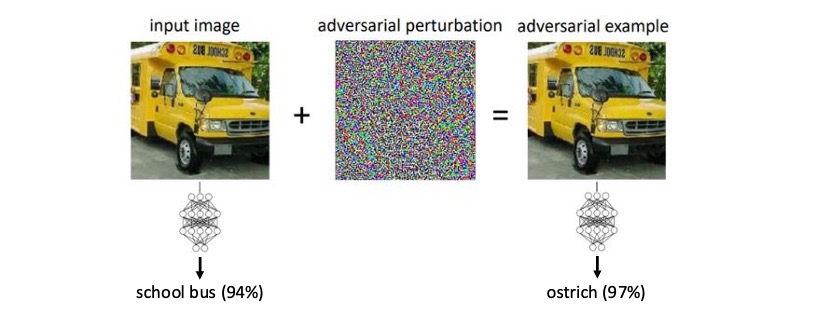
The stark difference between how humans and AI’s ‘understand’ buses has an unfortunate side effect. Researchers have discovered that AIs can be fooled by making minute changes to the numerical values of its input data, changes that are imperceptible to humans. In the example above, an AI that had been trained to confidently recognize a school bus is fooled into ‘thinking’ a bus is an ostrich. This is done simply by making small perturbations to the school bus image.

Conning an AI this way is called an adversarial attack. In the first part of my iMerit article Four Defenses Against Adversarial Attacks, I discuss why AIs are vulnerable to these attacks, how adversarial attacks can be formulated, and how such attacks can cause harm. The diagram below from the article illustrates how to devise a particular type of adversarial attack, a Black Box attack.
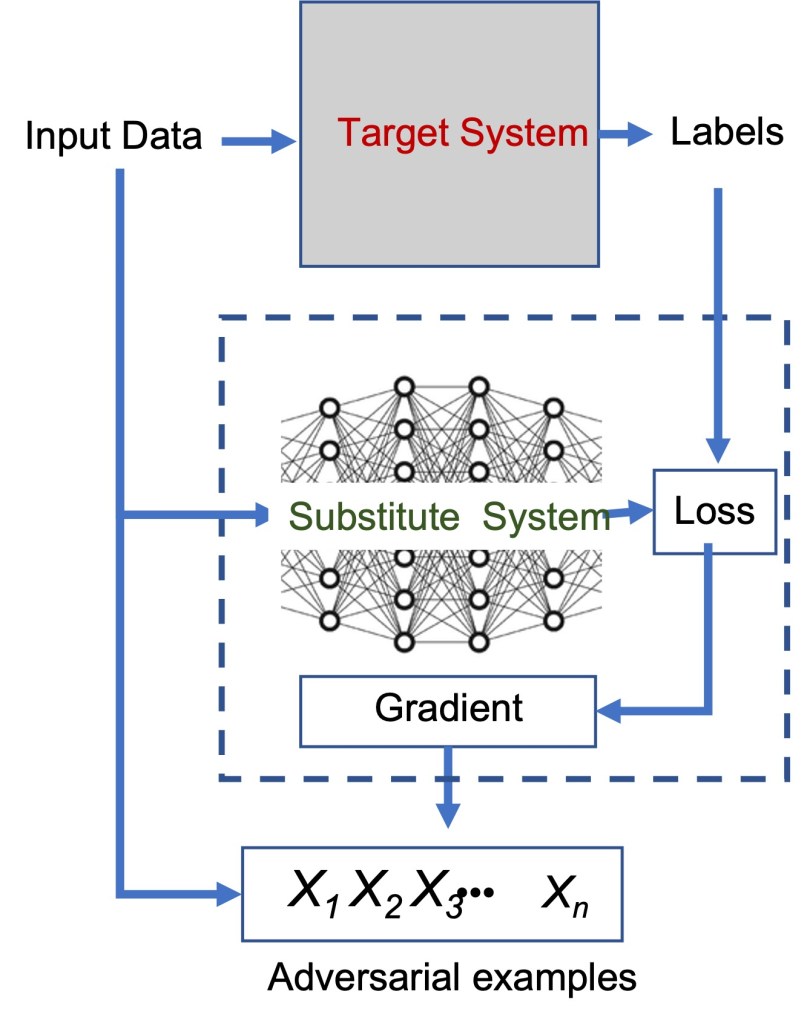
Black Box adversarial attack

Learning Common Sense from Video

Common sense makes humans very efficient learners, so machine learning researchers have been working on ways to imbue machines with at least some ‘common sense’. In a previous blog we discussed using pictures to train natural language processing systems, in a sense giving the systems partial ‘knowledge’ of what words represent in the physical world. ML systems can get even closer to common sense with a little help from video ML models and human teachers.

In my latest iMerit blog I discuss an innovative deep learning architecture that applies the concept of attention, commonly used in sequence models for language processing, to analyze motion patterns in video using only 30 percent of the computations used in previous approaches.

Next I discuss training such a video analysis system to learn the basic language of movement. For this training the human teacher goes beyond typical training data annotation, drawing on knowledge of the physical world to improvise representative examples of the basic concepts of movement. It is hoped that this will give the ML system a bit of ‘common sense’, allowing it to more easily learn new video analysis tasks.

Learning Words with Pictures

Natural language processing (NLP) machines have made great progress by learning to recognize complex statistical patterns in sentences and paragraphs. Work with modern deep learning models such as the transformer has shown that sufficiently large networks (hundreds of millions parameters) can do a good job processing language (e.g., translation), without having any information about what the words mean.

We humans make good use of meaning when we process language. We understand how the things, actions, and ideas described by language relate to each other. This gives us a big advantage over NLP machines – we don’t need the billions of examples these machines need to learn language.

NLP researchers have asked the question, “Is there some way to teach machines something about the meaning of words, and will that improve their performance?” This has led to the development of NLP systems that learn not just from samples of text, but also from digital images associated with the text, such as the one above from the COCO dataset. In my latest iMerit blog I describe such a system – the Vokenizer!

The Road to Human-Level Natural Language Processing

Language is a hallmark of human intelligence, and Natural Language Processing (NLP) has long been a goal of Artificial Intelligence. The ability of early computers to process rules and look up definitions made machine translation seem right around the corner. However language proved to be more complicated than rules and definitions.

The observation that humans use practical knowledge of the world to interpret language set off a quest to create vast databases of human knowledge to apply to NLP. But it wasn’t until deep learning became available that human-level NLP was achieved, using an approach quite unlike human language understanding.

In my latest iMerit blog I trace the path that led to modern NLP systems, which leave meaning to humans and let machines do what they are good at – finding patterns in data.